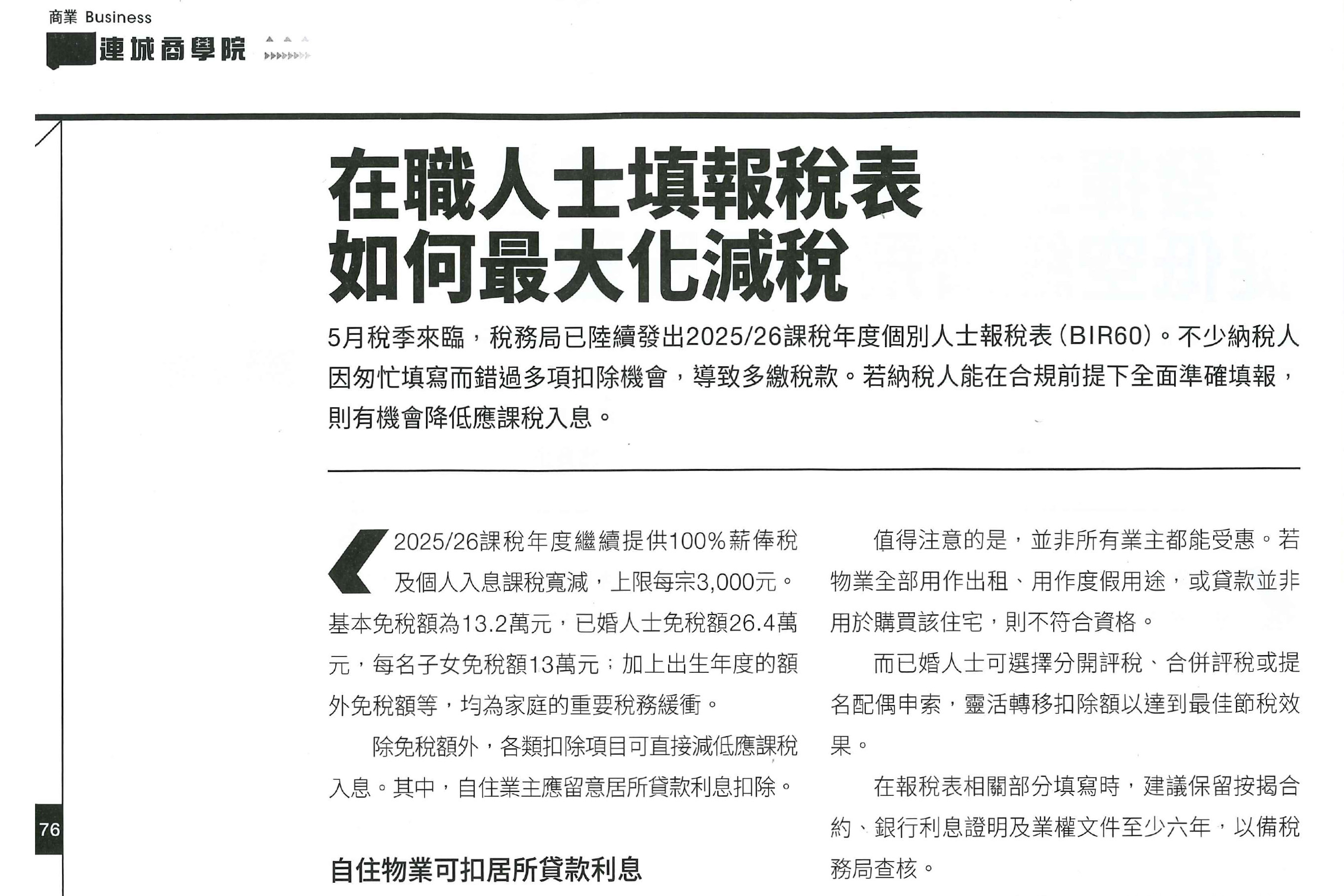
【CityLinkers Business School】How Employed Individuals Can Maximize Tax Savings When Filing Tax Returns
Many taxpayers, in their haste to file, miss out on various deduction opportunities, resulting in overpayment of tax. However, by filing accurately and in full compliance, taxpayers have the opportunity to reduce their assessable income.
For the 2025/26 tax year, a 100% rebate of salaries tax and personal assessment continues to be offered, capped at HK$3,000 per case. The basic allowance is HK$132,000, the married person’s allowance is HK$264,000, and the allowance for each child is HK$130,000. Additional allowances for the year of birth, among others, provide significant tax relief for families.
In addition to allowances, various deductions directly reduce assessable income. Owner-occupiers should pay particular attention to the deduction for home loan interest.
Deductible Home Loan Interest for Owner-occupied Property
Eligible individuals can deduct up to the basic annual limit of HK$100,000. Starting from the Year of Assessment 2024/25, an additional HK$20,000 may be claimed if specific conditions are met, bringing the total to HK$120,000. The deduction period spans up to 20 years of assessment and need not be continuous, allowing taxpayers to strategically claim in years with higher interest payments for maximum benefit.
To successfully claim the home loan interest deduction, several conditions must be met. First, the taxpayer must be the owner of the property (sole owner, joint tenant, or tenant in common, as recorded in the Land Registry). Second, the property must be located in Hong Kong. Third, the property must be used wholly or partly as the taxpayer’s residence during the year of assessment. If only partially owner-occupied, the deduction is calculated based on the proportion of owner-occupation.
Additionally, the loan must have been used to purchase the residence and secured by a mortgage on that property or other Hong Kong assets. The lending institution must be the government, a financial institution, a licensed moneylender, an employer, or an organization approved by the Inland Revenue Department. A car parking space within the same development may also be included in the claim, provided it is submitted together with the residential property claim.
It is important to note that not all owners qualify. If the property is rented out entirely, used as a holiday home, or the loan was not used to purchase the residence, the deduction does not apply.
Married individuals may choose separate assessment, joint assessment, or nominate their spouse to claim the deduction, flexibly transferring the allowance to achieve the best tax-saving result.
When completing the relevant sections of the tax return, taxpayers are advised to retain mortgage contracts, bank interest certificates, and title deeds for at least six years for review by the Inland Revenue Department.
Apart from home loan interest, there are other easily overlooked deduction items. For example, mandatory MPF contributions are deductible up to HK$18,000; Voluntary Health Insurance Scheme (VHIS) premiums are deductible up to HK$8,000 per insured person; and Qualifying Deferred Annuity Policies (QDAP) and Tax-Deductible Voluntary Contributions (TVC) to MPF schemes share a combined deduction limit of HK$60,000, making them suitable for medium- to long-term financial planning.
Other deductions include personal self-education expenses (up to HK$100,000, provided they are work-related); approved charitable donations of HK$100 or more, capped at 35% of income after deductible outgoings and depreciation allowances; and residential rent deduction for non-owner-occupying tenants, up to HK$100,000 per year.
Married individuals are encouraged to use personal assessment with joint filing to flexibly allocate various deductions for greater effect. Allowances for supporting parents or grandparents also require attention to residency duration and supporting documentation to avoid rejection due to insufficient proof.
The May tax filing season is an ideal time for employees to review their personal financial health. Taxpayers are advised to use the Inland Revenue Department’s tax calculator to simulate different scenarios. Through systematic planning, it is possible not only to legally reduce the tax burden but also to lay a solid foundation for long-term family financial management.
Disclaimer: The investment analysis and tips published on this page are for reference purposes only. Market conditions change rapidly. Readers should exercise prudence and stay informed of the latest market developments before making investment decisions. The publisher and related authors accept no liability for any losses incurred.
Paxson Fung, Partner, CityLinkers Group
For original article, please visit: https://www.edigest.hk/2007826

