An important feature of a trust is the separation of legal ownership (trustee) and beneficial ownership (beneficiaries). The settlor transfers the legal and beneficial title of the assets to the trustee who in turn holds the legal title, or the legal ownership of these assets on behalf of and for the benefit of the beneficiaries who are beneficial owners.
The beneficiaries do not hold legal title to the assets that are settled on trust. Trusts are commonly used for estate planning, asset protection, and managing charitable donations.
Trust or Company Service Provider (TCSP) licensee
Key Elements of Trusts setup in Hong Kong
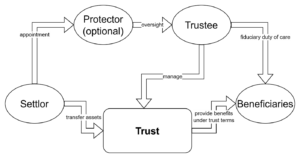 A typical trust structure consists of key roles: the Settlor, Trustee, Beneficiaries, and optionally a Protector. The Settlor transfers assets into the trust, which are managed by the Trustee according to the trust terms, for the benefit of the Beneficiaries. The Protector may be appointed to provide additional oversight and ensure the trust operates effectively.
What Trust Services Does CityLinkers Provide?
Why Set Up a Trust in Hong Kong?
- No Estate Duty: Hong Kong abolished estate duty in 2006. Assets held in a Hong Kong trust are not subject to estate or inheritance tax upon the settlor's death.
- Strong Legal Framework: Hong Kong trusts are governed by the Trustee Ordinance (Cap. 29), which was significantly modernised by the Trust Law (Amendment) Ordinance 2013. The amendments introduced settlor reserve powers, abolished the rule against perpetuities, and strengthened beneficiary protection.
- Tax Neutrality: Hong Kong operates a territorial tax system. Trust income derived from outside Hong Kong is generally not subject to Hong Kong profits tax. There is no capital gains tax in Hong Kong.
- Privacy and Confidentiality: Trust deeds are not publicly registered in Hong Kong, providing a high degree of privacy for settlors and beneficiaries.
- Asset Protection: Properly structured Hong Kong trusts can protect assets from creditors, forced heirship claims, and political instability in other jurisdictions.
What Types of Trusts Can CityLinkers Set Up?
- Discretionary Trusts — The most common structure, giving trustees discretion over distributions to beneficiaries
- Fixed Trusts — Beneficiaries have fixed entitlements as specified in the trust deed
- Family Trusts — Designed for multi-generational wealth succession and family governance
- Charitable Trusts — Established for charitable purposes with potential tax benefits
- Purpose Trusts — Non-charitable trusts established for specific purposes, commonly used in corporate structures
- Holding Trusts — Used to hold shares in private investment holding companies
What Is the Trust Set Up Process?
- Initial Consultation — Understanding your wealth structure, family circumstances, and objectives
- Trust Design — Recommending the optimal trust structure, trustee arrangement, and jurisdiction
- Document Drafting — Preparing the trust deed, letter of wishes, and supporting documents
- Asset Transfer — Effecting the transfer of assets into the trust
- TCSP Registration — Completing all regulatory filings under our TCSP licence
- Ongoing Administration — Trust accounting, distributions, reporting, and compliance management
What Are the Key Roles in a Trust?
How Does CityLinkers Ensure Trust Compliance?
- Customer Due Diligence (CDD) on all settlors, trustees, and beneficiaries
- Enhanced Due Diligence (EDD) for high-risk clients and politically exposed persons (PEPs)
- Ongoing monitoring of trust transactions and beneficial ownership
- Record-keeping for at least five years
- Suspicious transaction reporting to the Joint Financial Intelligence Unit (JFIU)
Contact CityLinkers today for a tailored trust solution
A TCSP (Trust or Company Service Provider) licence is issued by the Companies Registry under AMLO. Only licensed TCSPs can legally provide trust and company services in Hong Kong. CityLinkers holds TCSP licence TC006447, ensuring full regulatory compliance.
A standard discretionary trust can be established within 2 to 4 weeks once all due diligence is completed and the trust deed is finalised. More complex structures involving multiple jurisdictions or corporate trustees may take 4 to 8 weeks.
Hong Kong trusts can hold a wide range of assets including cash, listed securities, private company shares, real estate (both local and overseas), intellectual property, and other investment assets. The transfer of certain assets may require additional legal procedures.
Yes. Following the 2013 Trustee Ordinance amendments, settlors can reserve powers including investment management, trustee appointment/removal, and distribution directions, without invalidating the trust. However, excessive control may impact asset protection benefits.
A letter of wishes is a non-binding document from the settlor to the trustee providing guidance on how distributions should be made to beneficiaries. While not legally binding, trustees generally consider it carefully when exercising their discretion.
No. The 2013 amendments abolished the rule against perpetuities for Hong Kong trusts. A Hong Kong trust can now continue indefinitely, making it ideal for multi-generational wealth planning.
Hong Kong does not impose tax on trust distributions to beneficiaries. Trust income sourced outside Hong Kong is generally not subject to profits tax. Beneficiaries should consult their local tax advisors regarding any tax obligations in their jurisdiction of residence.