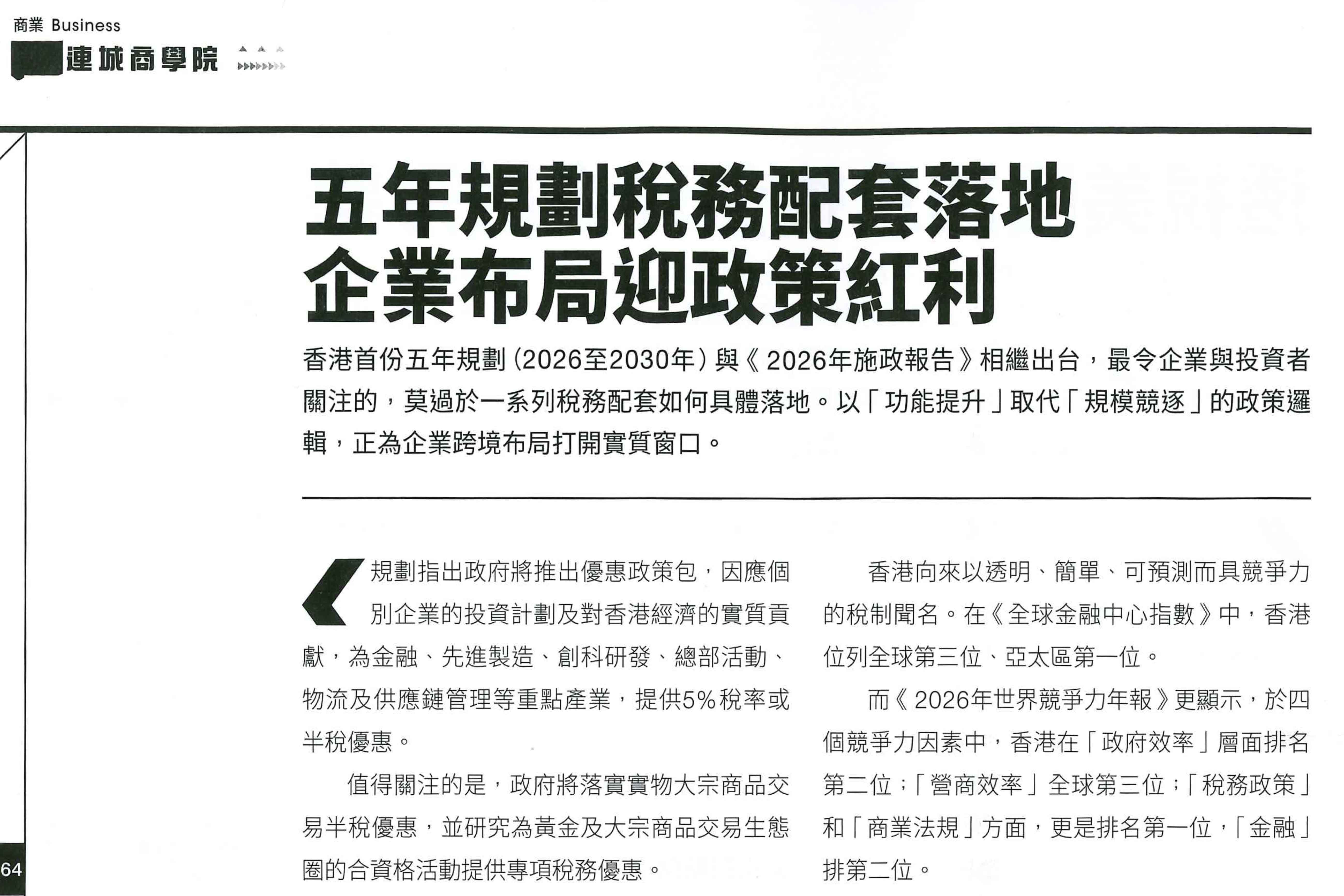
【CityLinkers Business School】Five-Year Plan Tax Measures Implemented, Corporate Layout Welcomes Policy Dividends
The plan states that the Government will launch an incentive package to provide a 5% tax rate or half-rate concession for key industries including finance, advanced manufacturing, innovation and technology research and development, headquarters activities, and logistics and supply chain management, based on individual enterprises’ investment plans and their substantive contribution to Hong Kong’s economy.
Notably, the Government will implement a half-rate tax concession for physical commodity trading, and study providing dedicated tax incentives for qualifying activities in the gold and commodity trading ecosystem.
In addition, the stamp duty waiver for REIT transfers of non-residential properties, as well as additional concessions for Corporate Treasury Centres (CTC), are planned to be submitted as bills in the first half of 2027.
Three Major Development Directions of the Plan
The plan focuses on the Government’s stated development directions for the international financial centre, including the offshore RMB business hub, cross-border wealth management and risk management.
Currently, Hong Kong handles over 75% of global offshore RMB payments, with a highly liquid capital pool of over HK$1 trillion. In the area of asset and wealth management, Hong Kong has surpassed Switzerland to become the world’s largest cross-border wealth management centre.
At the same time, the plan will also implement international tax reform requirements — Hong Kong has implemented the “global minimum tax” (BEPS 2.0) since January 2025, imposing a 15% minimum top-up tax on multinational groups with total revenue exceeding EUR 750 million in two consecutive financial years.
This means that, under the premise of compliance, Hong Kong can still maintain the attractiveness of its tax regime through “sub-sector-specific concessions” and “customised policy packages.”
Hong Kong has long been renowned for its transparent, simple, and predictable and competitive tax regime. In the “Global Financial Centres Index,” Hong Kong ranks third globally and first in the Asia-Pacific region.
The “2026 World Competitiveness Yearbook” further shows that among various competitiveness factors, Hong Kong ranks second in “Government Efficiency”; third globally in “Business Efficiency”; and first in “Tax Policy” and “Business Legislation,” and second in “Finance.”
Towards a Financially Empowered City
The author believes that enterprises should, rather than fixating on regional competitors, focus on the long-term direction of the plan and align with implementation measures in advance — whether establishing a CTC, setting up a single family office, or leveraging Hong Kong’s leading Environmental, Social and Governance (ESG) standards to expand Greater Bay Area services, all are worth planning early.
When utilising various tax incentives, it is also advisable to consult professional tax advisors to clarify applicable conditions and compliance boundaries.
Hong Kong is moving from a “financial city” to a “financially empowered city.” Leveraging its positioning as a “super connector” and “going global platform,” Hong Kong strives to become an indispensable gateway and preferred destination for global capital.
For enterprises and investors with international layouts, now is the critical window to seize the momentum and ride the policy tailwind.
Paxson Fung, Partner, CityLinkers Group

