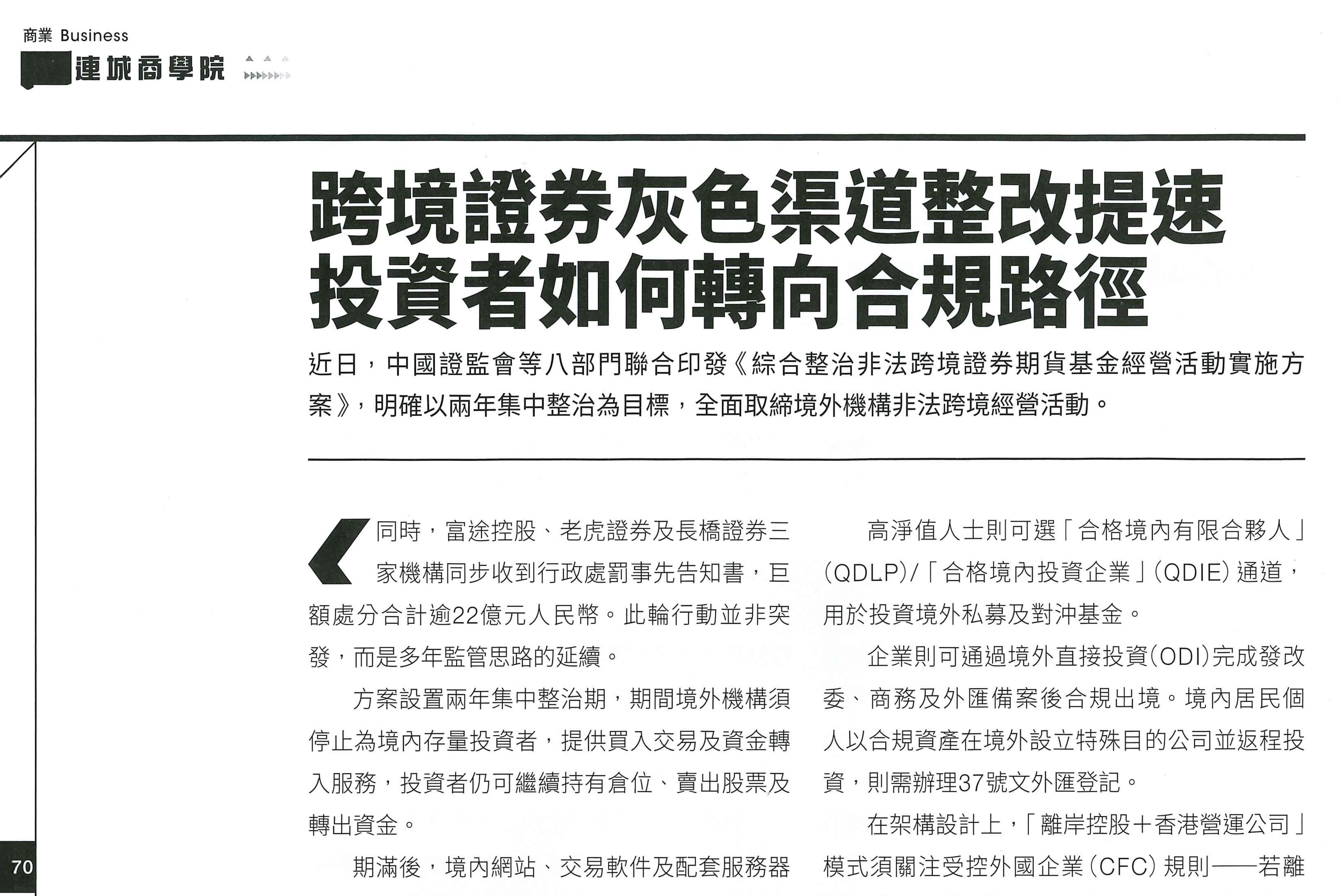
【CityLinkers Business School】Intensifying Crackdown on Grey-Channel Cross-Border Securities: How Investors Can Shift to Compliant Routes
At the same time, three brokerages — Futu Holdings, Tiger Brokers, and Longbridge Securities — simultaneously received administrative penalty advance notices, with total fines exceeding RMB 2.2 billion. This enforcement action is not sudden, but rather a continuation of regulatory thinking that has been developing over many years.
The plan establishes a two-year intensive rectification period, during which overseas institutions must cease providing purchase transaction and fund deposit services to existing onshore investors. Investors may continue to hold their positions, sell stocks, and withdraw funds.
After the rectification period ends, all domestic-facing websites, trading software, and supporting servers must be completely shut down.
The Hong Kong Monetary Authority (HKMA) has required banks to take additional measures, including closing accounts opened with suspicious or forged documents; closing dormant accounts with zero balances; implementing stricter verification of funding sources and bank accounts for newly opened investment accounts, requiring Mainland residents opening new investment accounts to make a written declaration confirming that all funds originate from legitimate sources outside Mainland China.
QDII Funds Open to Investors
For Mainland investors seeking to participate in global investing, compliant channels are clear and continuously improving. The SFC guides investors to conduct overseas investments through legal channels such as the Stock Connect programs, Qualified Domestic Institutional Investor (QDII) schemes, and the Cross-Boundary Wealth Management Connect.
Compliant capital outbound channels remain fully open. The individual convenience foreign exchange quota (USD 50,000 per year) is strictly limited to current-account items such as tourism, education, and may not be used for overseas property purchases or securities investments.
QDII funds are open to all investors, with the current aggregate quota standing at approximately USD 176.1 billion. However, quotas remain persistently tight, and some popular products have already imposed purchase limits or are trading at significant premiums.
For high-net-worth individuals, the Qualified Domestic Limited Partner (QDLP) / Qualified Domestic Investment Enterprise (QDIE) channels are available for investing in overseas private equity and hedge funds.
For corporations, outbound capital can be legally deployed through Overseas Direct Investment (ODI) after completing the necessary filings with the National Development and Reform Commission (NDRC), the Ministry of Commerce, and the foreign exchange authorities. For domestic individuals who use lawfully sourced assets to establish offshore special purpose vehicles (SPVs) for round-trip investment into China, SAFE Circular 37 foreign exchange registration is required.
In terms of structural design, the “offshore holding company + Hong Kong operating company” model requires attention to the Controlled Foreign Corporation (CFC) rules — if the offshore entity lacks substantial business operations and does not distribute profits over an extended period, tax authorities have the power to deem the profits as distributed and impose tax on the onshore shareholders accordingly.
With respect to offshore trusts, while Hong Kong’s Trustee Ordinance allows the settlor to retain investment powers, if the settlor also retains the right to change beneficiaries or remove trustees, the trust may be deemed a “sham trust” and subject to piercing by tax or judicial authorities.
Under the Common Reporting Standard (CRS) framework, the settlor, trustee, protector, and beneficiaries of a trust may all be identified as “controlling persons,” and relevant information must be reported and automatically exchanged with the tax residence jurisdictions of all parties involved.
In the face of an increasingly closed regulatory loop, three red lines must never be crossed: illegal funding sources may result in account freezes, fines, and even criminal liability; sham trusts — if substantively used for tax avoidance or asset concealment — tax authorities may pierce the trust under the “substance-over-form” principle and impose tax accordingly; fraudulent conveyance for debt avoidance constitutes a fraudulent transfer, and courts may set aside such trusts.
The safest approach is to return to compliant channels. The optimal pathway depends on individual factors such as capital size, investment objectives, and tax residency status. It is strongly recommended to consult professional tax, legal, and financial advisors to develop a tailored solution.
Paxson Fung, Partner, CityLinkers Group
For original article, please visit: https://www.edigest.hk/2017538

