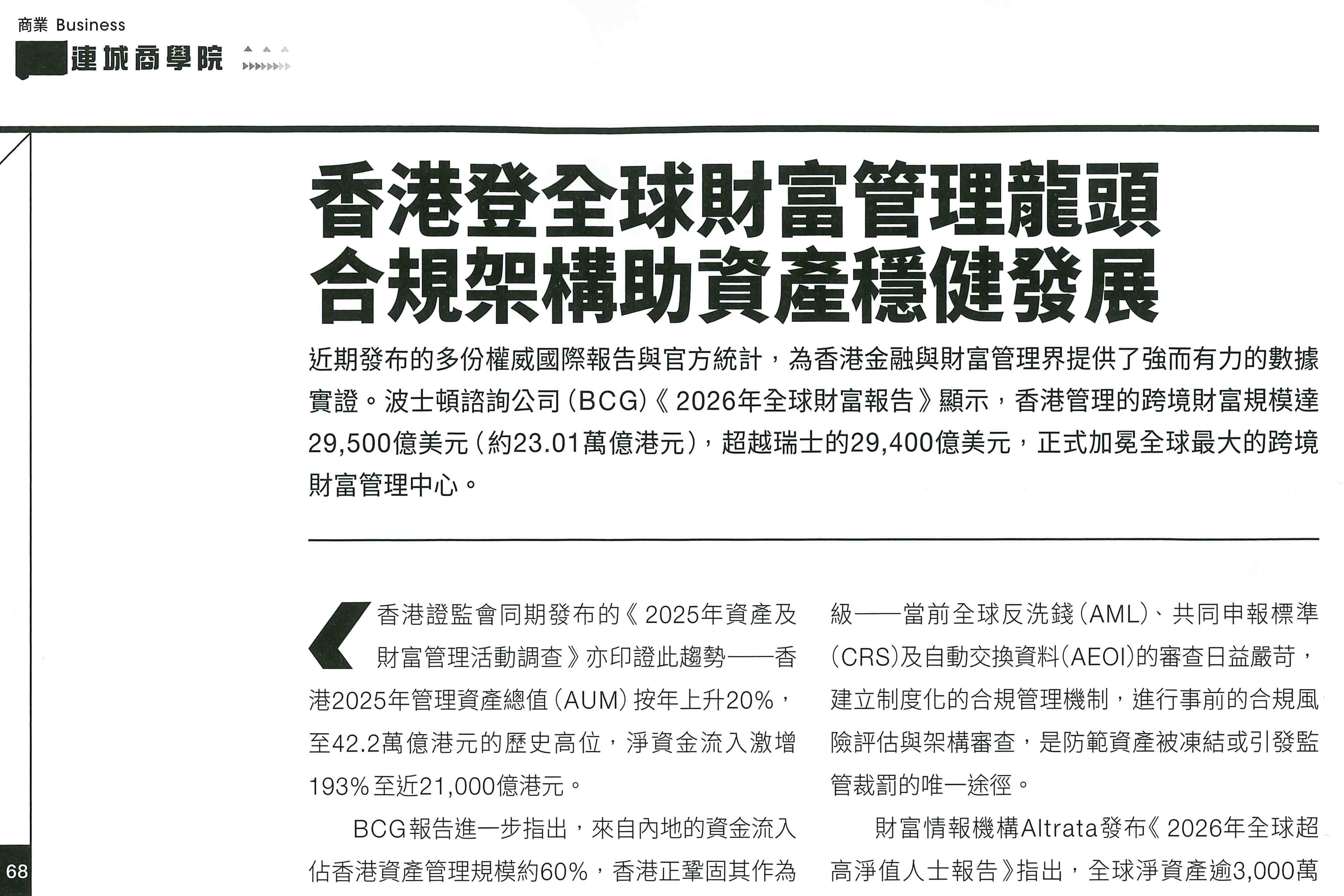
【CityLinkers Business School】Hong Kong Tops Wealth Rankings; Compliance Ensures Asset Stability
The Boston Consulting Group’s (BCG) “2026 Global Wealth Report” shows that Hong Kong manages cross-border wealth of USD 2.95 trillion (equivalent to approximately HKD 23.01 trillion), surpassing Switzerland’s USD 2.94 trillion, officially crowning Hong Kong as the world’s largest cross-border wealth management centre.
The Securities and Futures Commission (SFC) of Hong Kong simultaneously released its “Asset and Wealth Management Activities Survey 2025”, which corroborates this trend — Hong Kong’s total assets under management (AUM) in 2025 rose 20% year-on-year to a record high of HKD 42.2 trillion, while net fund inflows surged 193% to nearly HKD 2.1 trillion.
The BCG report further points out that fund inflows from Mainland China account for approximately 60% of Hong Kong’s asset management scale, and Hong Kong is consolidating its unique position as China’s gateway to the global market.
Leveraging the unique advantages under the “One Country, Two Systems” framework, Hong Kong is attracting an increasing number of ultra-high-net-worth individuals and family offices to establish their investments here. The massive fund inflows are by no means simple “hot money parking,” but rather strategic allocations accompanying corporate global expansion and cross-border commerce.
When the scale of funds and asset classes span different jurisdictions, efficient financial management — including cross-border liquidity optimisation, balance sheet management, and risk diversification of profit reinvestment — becomes the primary challenge for overseas-expanding enterprises and wealthy families.
Under the global minimum tax framework (BEPS 2.0), a mere “low-tax” or “tax-exempt” approach can no longer meet the requirements of modern asset protection. How to establish cross-border tax structures with commercial substance under legal and compliant premises and balance the tax filing between offshore structures and onshore operations, has become the key to the long-term and stable operation of family offices.
The free flow of wealth is inevitably accompanied by a dual upgrade in regulation — with global anti-money laundering (AML), the Common Reporting Standard (CRS), and the Automatic Exchange of Information (AEOI) becoming increasingly stringent in their reviews, establishing an institutionalised compliance management mechanism, and conducting ex-ante compliance risk assessments and structural reviews, is the only way to prevent asset freezes or regulatory penalties.
Wealth intelligence organisation Altrata released the “World Ultra Wealth Report 2026”, indicating that the number of ultra-high-net-worth individuals with net assets exceeding USD 30 million globally had reached 556,900 by the end of last year.
This group, which holds the core of global wealth, is collectively entering a critical period of wealth succession. Faced with family structures involving multiple children and cross-border nationalities, a simple traditional will is no longer sufficient. Establishing trusts is becoming an indispensable top-level governance tool: through the transfer of asset ownership, an asset firewall is established to achieve effective separation of personal and family wealth from corporate operational risks; compared with one-time inheritance, trusts can set flexible distribution conditions to prevent excessive squandering by future generations; trust structures can also transcend the lifespan of an individual, avoid lengthy probate procedures, and ensure that family wealth is transferred across generations according to the founder’s wishes.
From Hong Kong’s total assets under management reaching a record high, to its cross-border wealth scale ranking first globally, the empirical data has already provided an objective answer to the resilience of Hong Kong as a financial centre. Only by effectively combining financial management, tax structuring, compliance management, and trust protection can a robust line of defence for steady growth and preservation of capital be established amidst the new normal of highly regulated and highly volatile global finance.
Disclaimer: The investment analysis and tips published on this page are for reference purposes only. Market conditions change rapidly. Readers should exercise prudence and stay informed of the latest market developments before making investment decisions. The publisher and related authors accept no liability for any losses incurred.
CityLinkers Group, Partner, Paxson Fung
For original article, please visit: https://www.edigest.hk/2027374

