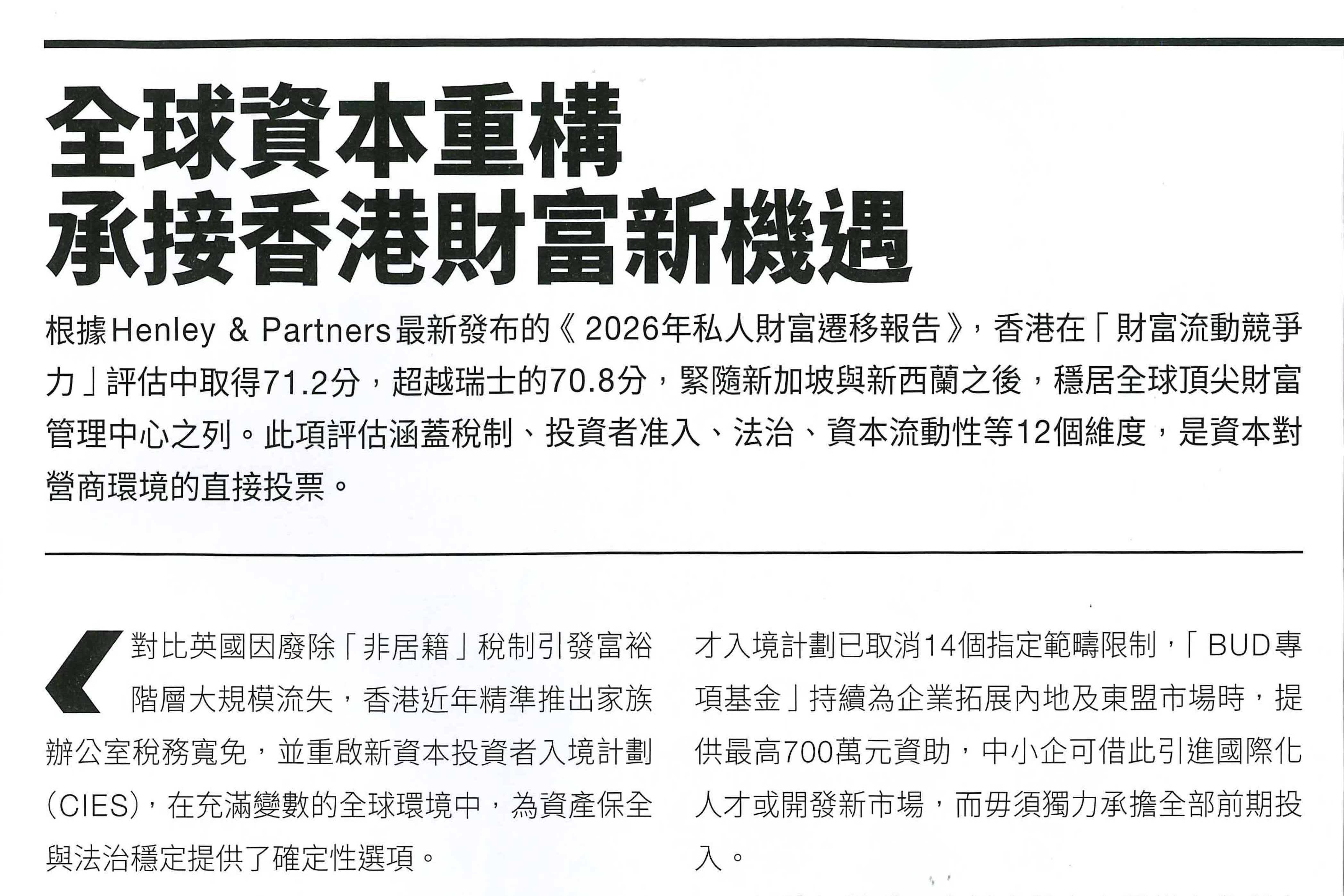
【CityLinkers Business School】Global Capital Restructuring – Seizing Hong Kong’s New Wealth Opportunities
This assessment covers 12 dimensions, including tax systems, investor access, rule of law, and capital liquidity, and represents a direct vote of confidence by capital in the business environment.
In contrast to the United Kingdom, where the abolition of the non-domicile tax regime has triggered a large-scale exodus of affluent individuals, Hong Kong has in recent years precisely introduced tax concessions for family offices and relaunched the New Capital Investor Entrant Scheme (CIES). In a volatile global environment, this provides a certain option for asset preservation and legal stability.
Making Good Use of Government Funding to Reduce Transition Costs
Recently, several global top-tier multinational insurance groups have concurrently undertaken large-scale business expansions in Hong Kong. Moving beyond the traditional retail insurance framework, they are undergoing a comprehensive transformation towards “integrated wealth management and succession planning.”
In line with this trend, the industry is promoting integrated products that combine large-sum insurance policies with trust structures. This “Hong Kong hub + offshore structure” model offers significant advantages: on the front end, it leverages Hong Kong’s status as an international financial centre for professional services and fund settlement capabilities; on the back end, it uses offshore structures to build asset protection shields and achieve cross-jurisdictional tax optimisation.
For businesses and investors alike, this major capital migration contains substantial commercial opportunities—provided that one accurately understands the evolution of market demand and adjusts their positioning accordingly.
First, as mainland Chinese enterprises go global and high-net-worth families internationalise, there is a growing need to strengthen cross-border compliance capabilities. Professional financial and tax institutions can be engaged to handle complex cross-border tax issues, foreign exchange controls, and structuring design.
Second, businesses can focus on specific links in the industrial chain. Small and medium-sized enterprises may choose to excel in one or several of these links, or establish referral partnerships with larger institutions.
Third, government funding should be used to reduce transition costs. The Technology Talent Admission Scheme has removed restrictions on 14 designated sectors, and the BUD Special Fund continues to provide up to HK$7 million in funding for enterprises expanding into mainland China and ASEAN markets. SMEs can leverage this to bring in international talent or develop new markets, without bearing the full upfront costs alone.
Sole proprietors and self-employed professionals also have room to participate. With the expansion of Cross‑boundary Wealth Management Connect, Qualified Domestic Institutional Investor (QDII) schemes, and family office-related businesses, demand is rising for compliance officers, tax advisors, and trust administrators who are bilingual and familiar with regulatory differences between the two jurisdictions.
A Robust Customer Due Diligence Process Must Be Established
Opportunities often go hand in hand with compliance risks. The Hong Kong Monetary Authority and the Securities and Futures Commission have recently tightened supervision over accounts of mainland investors, requiring banks to conduct retroactive checks on accounts opened with suspicious documents and to impose stricter source-of-funds verification for new investment accounts.
This means that enterprises providing related services must establish a robust customer due diligence process, retain complete evidence of fund trails, and avoid being implicated by client non-compliance.
Looking at objective research data, Hong Kong’s rise confirms that it is entering a new golden era of wealth management. As more mainland enterprises go global and more high-net-worth families internationalise, Hong Kong’s role as the “super connector” between mainland China and global capital will possess irreplaceable strategic value. Those who position themselves early will be best placed to share in the greatest dividends of this major capital reshuffle.
Paxson Fung, Partner, CityLinkers Group
For original article, please visit: https://www.edigest.hk/2021159

