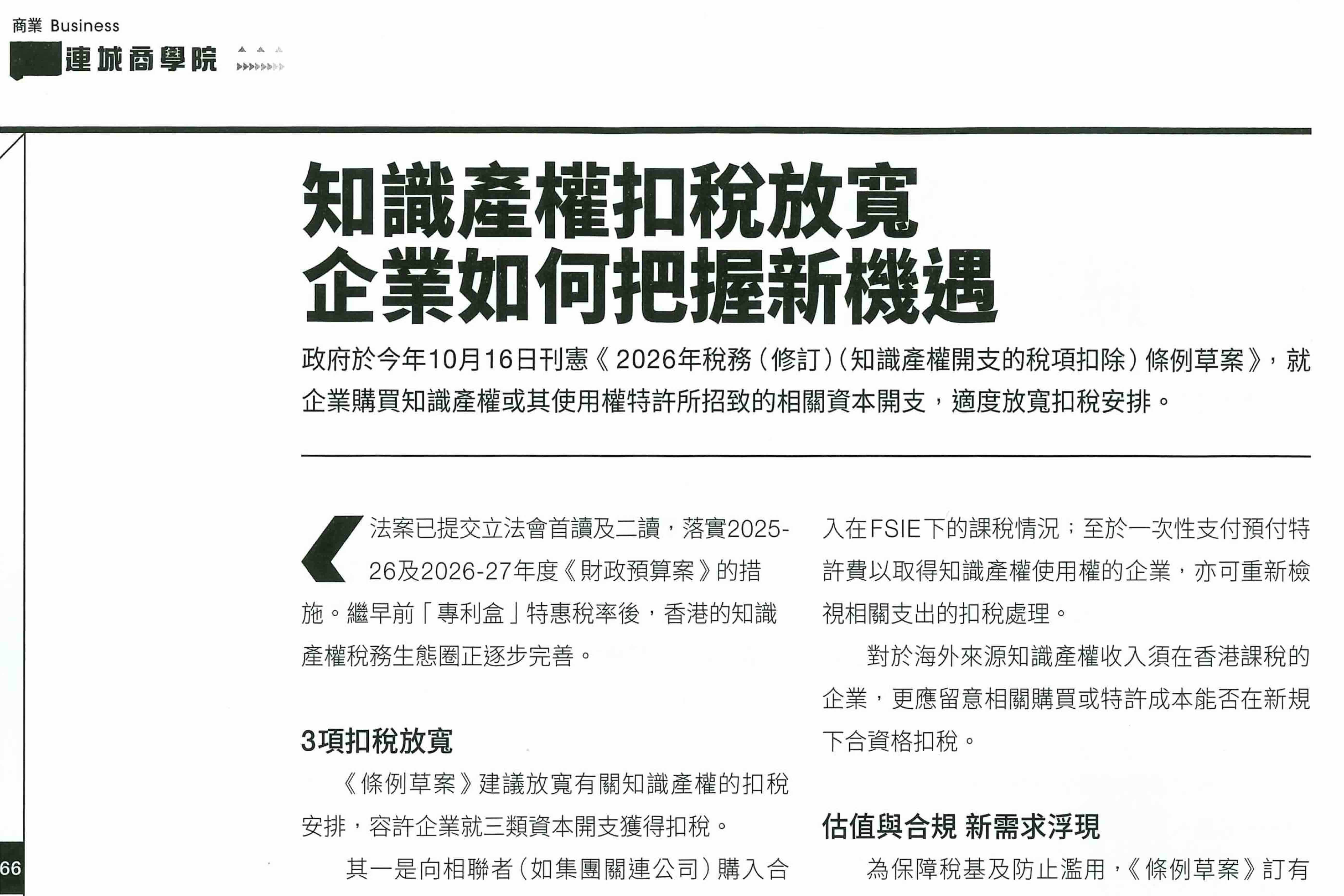
【CityLinkers Business School】Relaxation of Tax Deductions for Intellectual Property: How Can Enterprises Seize the New Opportunities?
The Bill has been introduced into the Legislative Council for First and Second Reading, implementing the measures in the 2025-26 and 2026-27 Budgets. Following the earlier “patent box” preferential tax rate, Hong Kong’s IP tax ecosystem is gradually being enhanced.
Three Deduction Relaxations
The Bill proposes to relax the tax deduction arrangements for IP, allowing enterprises to claim deductions on three types of capital expenditure.
First, capital expenditure incurred in purchasing qualifying IP from associates (such as group-affiliated companies) will be deductible. This encourages multinational enterprises to centralise IP management in Hong Kong and facilitates intra-group local transfers.
Second, for the purchase of qualifying IP for use by licence holders outside Hong Kong, where the licence income is deemed chargeable to profits tax in Hong Kong under the Foreign-sourced Income Exemption (FSIE) regime, the capital expenditure on purchasing such IP may be deducted on a proportional basis.
Third, upfront licence fees paid by enterprises under licensing arrangements for the use of qualifying IP will also be deductible. This aims to further promote the commercialisation of IP.
It is worth noting that the proposed amendments apply to contracts entered into on or after 1 April 2026, i.e. they have retrospective effect.
Which enterprises benefit most? From a practical perspective, several types of enterprises stand to benefit most.5
Multinational groups planning to transfer IP to Hong Kong companies (including purchasing from another group company) can assess the savings under the new deduction arrangements; enterprises that establish companies in Hong Kong and license IP to overseas businesses for use should review the tax treatment of their licence income under FSIE; and enterprises that make one-off upfront licence fee payments to acquire the right to use IP may also re-examine the deduction treatment of such expenditure.
Enterprises whose overseas-sourced IP income is chargeable to tax in Hong Kong should pay particular attention to whether the relevant purchase or licensing costs qualify for deduction under the new rules.
Valuation and Compliance: New Demands Emerging
To safeguard the tax base and prevent abuse, the Bill contains stringent safeguard measures, including the introduction of a “main purpose test” for the purchase of IP from associates, a method for calculating the deductible amount for IP purchased from Hong Kong business associates, and the requirement to prepare an independent third-party valuation report where capital expenditure incurred in purchasing IP from non-Hong Kong business associates, or in acquiring licences to use IP, exceeds a specified threshold.
This means that, in addition to tax planning, demand for IP valuation and compliance framework reviews will rise in tandem.
Before enjoying tax deductions, enterprises should first consult professional institutions with multinational experience on transaction structures, deduction eligibility and valuation requirements, so as to avoid affecting claims due to insufficient documentation or valuation.
Overall, this amendment further reduces IP transaction costs. Enterprises intending to use Hong Kong as a regional headquarters or IP management platform should review their existing and proposed IP contracts as early as possible and consult professional advisers on deduction arrangements and structure design, so as to benefit reliably once the policy is implemented.
Disclaimer: The investment analysis and tips published on this page are for reference purposes only. Market conditions change rapidly. Readers should exercise prudence and stay informed of the latest market developments before making investment decisions. The publisher and related authors accept no liability for any losses incurred.
Paxson Fung, Partner, CityLinkers Group
For original article, please visit: https://www.edigest.hk/2050485

